


Angry Smash
Tripledot Studios Limited
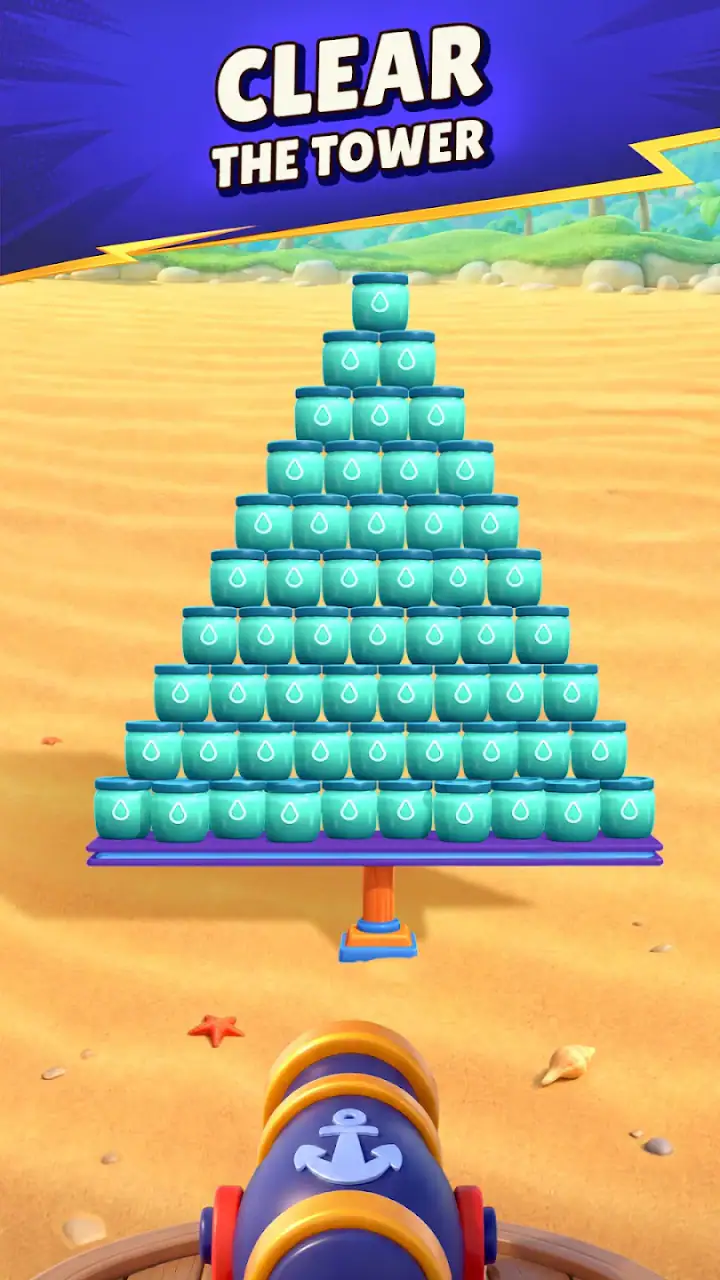
I spent time with Angry Smash as a quick, casual cannon game built around a simple promise: aim, fire, break through what is in the way, and keep moving across an island of levels. That basic loop is easy to understand within moments, which is exactly why it works well when I want something light rather than a game that demands a long tutorial or a serious time commitment.
What makes the experience worth discussing is not the size of its feature list, but how it handles momentum. Each attempt gives me a clear immediate task, while the larger attraction comes from seeing how far I can push through the level sequence. The game is free to download, suitable for Everyone, and comes from Tripledot Studios Limited, a developer with a strong focus on accessible mobile play. Its current version is 1.5.0, and it runs on Android 7.1 or later.
The central question is whether firing a cannon at obstacles can stay interesting after the first few minutes. My answer is yes, provided you enjoy compact, repeatable challenges and do not expect a deep strategy game. The appeal is strongest in short sessions, where the next obstacle gives me just enough reason to try one more shot without turning the whole experience into a demanding project.
How the first goals create momentum
The opening rhythm is deliberately direct. I am not asked to learn a complicated control scheme before playing. The cannon is the focus, and the objective is readable: line up a shot, release it, and watch the environment react. That clarity gives the early levels a useful sense of purpose. Even when a stage is simple, I know what I am trying to accomplish and can immediately judge whether my shot was effective.
This kind of design is especially comfortable on a phone. I can play while waiting for a coffee, during a short break, or at the end of the day when I want something more active than scrolling but less involved than a full adventure game. A single level can function as a small self-contained challenge, so I do not need to reserve a large block of time to feel that I have made progress.
Related News






The first goals also teach the player to think about timing and positioning rather than simply tapping as quickly as possible. A cannon game can become flat if every obstacle falls to the same shot, so the enjoyment depends on noticing how the target is arranged and deciding when a shot is worth taking. I found that the most satisfying moments came when I paused briefly, adjusted my aim, and cleared a problem with less waste than I expected.
The useful early habit is to treat every shot as a small puzzle, not just an attack. That mindset makes the basic loop more involving. Instead of firing immediately because the target is visible, I look at the route ahead and consider whether a direct hit will open the best path. This does not turn the game into a complex physics simulator, but it gives the simple controls a little more thought.
Players looking for a story, character development, or a large world to explore should set their expectations differently. The island is a setting for the levels, not a substitute for a narrative campaign. I would recommend it to someone who likes quick objectives and visible destruction, not to someone choosing a mobile game primarily for dialogue, role-playing choices, or a long-form adventure.
Gallery
What progress feels like during ordinary play
Progress in Angry Smash is communicated through the act of getting through levels rather than through a complicated collection of systems. Clearing one stage gives me a straightforward reason to begin the next. That simplicity is a strength for casual players because there is little administrative work between challenges. I do not have to spend much time sorting menus before returning to the cannon.
At the same time, this approach means the game’s sense of advancement depends heavily on the quality and variation of the stages. When the obstacle arrangement gives me a different problem to solve, the next level feels meaningful. When the task feels too close to the previous one, the forward motion becomes more functional than exciting. The game is at its best when the island route suggests a steady stream of fresh situations rather than a long repetition of the same shot.
I also like that the progress loop remains understandable without requiring the player to memorize a large set of rules. Someone can put the game down and return later without spending several minutes remembering a character build or a complicated upgrade path. That makes it well suited to irregular play. If I only have time for a few attempts today, I can still come back another day and understand what I am doing.
There is a trade-off here. Players who enjoy unlocking many distinct tools, collecting equipment, or building a detailed loadout may find the progression less satisfying than in a more system-heavy casual game. Angry Smash concentrates its appeal in the moment of aiming and breaking through. It does not need a crowded progression screen to make that loop accessible, but the same restraint can make long sessions feel less rewarding for people who need constant customization.
One practical way to get more from the progression is to avoid rushing through every stage simply to reach the next one. I found it more enjoyable to replay a tricky section immediately when a shot felt careless. That turns a failed attempt into a small skill check: can I improve the angle, fire earlier, or choose a safer line? This is a better use of the game than treating every level as a box to tick as quickly as possible.
Challenge, pacing, and the point where it may slow down
The difficulty curve matters more here than it might in a larger casual title because the core action is so focused. Early success needs to feel welcoming, but later stages need enough resistance to prevent the cannon from becoming automatic. In my experience, the most effective challenge comes from situations that make me reconsider the first shot rather than simply making the target harder to hit.
A good level asks for a small adjustment in thinking. I may need to aim around an obstacle, wait for a better opening, or accept that the obvious target is not the best first target. Those moments create a gentle increase in difficulty without requiring advanced controls. The game remains approachable because the solution is usually visible once I slow down and read the scene.
That pacing also makes failure relatively easy to accept. A missed shot is not automatically frustrating when I understand why it failed. If I fired too soon or aimed at the wrong section, I can correct that on the next attempt. This is an important distinction for a casual game: the challenge feels fairer when the player can identify the mistake instead of blaming an unclear rule.
Still, the experience will not suit everyone. If you prefer constant acceleration, competitive multiplayer pressure, or highly demanding precision, the early pace may feel too gentle. Conversely, if repeated attempts at a similar cannon puzzle irritate you, the later part of a session may feel slower than the opening. The game’s sweet spot is the middle ground between passive entertainment and intense action.
My strongest tip is to use short sessions when the pacing starts to flatten. Because the controls are easy to remember, taking a break does not create a barrier to returning. A few minutes away can make the next group of levels feel more inviting than forcing yourself through a long sitting after the loop has stopped feeling fresh. This is one of those games that benefits from being treated as a pocket activity rather than a marathon.
Compared with familiar match-style casual games, Angry Smash offers less emphasis on arranging symbols or building chains and more emphasis on aiming and immediate physical reaction. Compared with endless runners, it gives me a clearer stage objective instead of asking me to survive for as long as possible. It is also less demanding than a full puzzle title that expects several steps of planning. The trade-off is that its variety must come from the level situations, since the basic action remains deliberately narrow.
What keeps me playing, and what can create pressure
The retention appeal comes from a clean promise: there is another level to clear, another obstacle arrangement to understand, and another chance to improve a shot that did not work. That is enough for casual motivation when the stages remain distinct. I often found myself continuing not because I needed a reward, but because I wanted to see whether the next section would ask for a different approach.
That kind of motivation is healthier for me than a game that constantly interrupts play with complicated tasks. The cannon stays central, and the route through the island gives the session a visible direction. I can focus on the action instead of managing a long checklist. For a player who wants a low-friction game, that is a meaningful advantage.
There is also a natural pressure in any level-based game: stopping can feel like leaving an unfinished path. Angry Smash uses that feeling effectively when a stage ends with a near miss or when I know I was one careful adjustment away from success. The pressure is mild, but it can still encourage “one more try” behavior. I would be careful with that if I were playing when tired, especially because the game is easy to start and quick to resume.
In-app purchases range from $0.99 to $99.99 per item. That is worth considering before playing for long periods. The free entry makes it easy to test the core loop, but anyone who dislikes purchase prompts or tends to spend impulsively should decide in advance whether they will buy anything. I prefer setting a personal limit before opening a free-to-play game, and I would recommend the same approach here.
The age rating of Everyone makes the game approachable for a broad audience, including families looking for a simple action title. Even so, parents should still keep an eye on purchasing habits when a game includes optional paid items. The accessible presentation and straightforward controls make it easy for a younger player to understand, while the presence of purchases makes device-level safeguards a sensible practical step.
Another consideration is attention. This is not a game I would choose when I want a quiet, purely relaxing activity, because aiming and watching the result require at least a little focus. It is better for a short mental reset than for multitasking. If I am distracted, I am more likely to fire without thinking and then blame the level for a mistake that was really mine.
Who should download it and who should choose something else
I think Angry Smash is a good match for players who enjoy short levels, simple controls, and the satisfaction of clearing obstacles with a well-placed shot. It is particularly suitable for someone who wants a casual game that can be understood immediately but still offers small decisions within each stage. The free price makes trying it low-risk, while the Everyone rating broadens its appeal.
It is also a sensible choice for people who play in irregular bursts. The current version, 1.5.0, supports a straightforward return-to-play experience because the central mechanic is easy to remember. I do not need to rebuild a strategy in my head after a day away. I can pick up the cannon, inspect the obstacle layout, and begin making decisions again.
I would skip it if my priority were a deep progression tree, a substantial narrative, online competition, or a large set of character abilities. I would also look elsewhere if I wanted a game where every session feels dramatically different. A match-three game may offer more variety through combinations, an endless runner may provide more urgency, and a full puzzle game may reward longer planning. Angry Smash is narrower, and its value depends on whether that narrow focus sounds appealing rather than limiting.
For a realistic everyday example, I can imagine playing it during a ten-minute commute while seated safely, using a few levels as a break from work. I would not expect to finish a major quest or develop a complex build in that time, but I could complete several small objectives and stop without losing the thread. That is the kind of use case where the design makes the most sense: compact entertainment with a clear beginning and end to each attempt.
The high user response also suggests that the concept connects with its intended audience. The game holds a 4.9 average from around 7,700 ratings, alongside roughly 230 written reviews and over 100,000 installs. Those figures do not change my personal assessment, but they fit what I experienced: the game is easy to understand and immediately playable, which are powerful qualities in the casual category.
My verdict on the progression loop
Angry Smash succeeds by keeping its ambitions focused. It gives me a cannon, a sequence of island levels, and obstacles that invite a little more thought than a mindless tap. The early goals are clear, the progress is easy to follow, and the challenge works best when it encourages me to improve my aim rather than punish me with confusion.
Its main limitation is the same thing that makes it approachable: the loop is concentrated. Players who need extensive unlocks, deep customization, or constant novelty may run out of reasons to continue sooner than players who enjoy repeating a satisfying action with gradually changing setups. The in-app purchase range also means I would approach longer play with a spending boundary already in mind.
For me, the best way to enjoy it is in short sessions, taking time to read each obstacle arrangement and treating failed shots as information. I would recommend it to a friend who wants a friendly casual game with immediate goals and a little aiming skill, especially if they prefer level-based play over endless survival. If your ideal mobile game is simple to start, easy to pause, and satisfying when one careful shot clears the way, Angry Smash is worth trying.
FAQs for Angry Smash
What is Angry Smash, and how does the gameplay work?
Angry Smash is an action-focused mobile game built around fast-paced smashing and destruction challenges. Players typically control a character or tool, break objects, defeat obstacles, and complete short levels while aiming for high scores. The gameplay is easy to understand, but later stages can require better timing, quicker reactions, and smarter use of available abilities.
Is Angry Smash free to download and play?
Angry Smash can generally be downloaded for free on supported mobile devices, allowing players to try the main gameplay without an initial purchase. However, the game may include optional in-app purchases, advertisements, or paid items that can improve progression or remove interruptions. Before downloading, check the store listing for the current pricing, payment options, and regional availability.
Does Angry Smash require an internet connection?
The basic levels of Angry Smash may be playable without a constant internet connection, which makes it convenient for short sessions while traveling or when mobile data is unavailable. Nevertheless, certain features—such as advertisements, online rankings, cloud synchronization, events, or updates—may require internet access. Availability of offline functions can also vary between Android and iOS versions.
Is Angry Smash suitable for children?
Angry Smash is usually simple to learn because its controls and objectives are designed around quick actions rather than complicated instructions. Parents should still review the age rating, advertising content, and in-app purchase settings before allowing children to play. If the game includes cartoon violence, competitive elements, or frequent prompts to buy items, parental controls are recommended for younger users.
What devices are compatible with Angry Smash, and what should I check before installing it?
Compatibility depends on the specific version of Angry Smash available for Android or iOS. Before installing, check the official store page for the required operating-system version, download size, permissions, and available storage space. A device with updated software and enough free memory will generally provide smoother performance, while older phones may experience slower loading or reduced visual quality.
Pros
- Fast
- satisfying gameplay that is easy to understand from the first round.
- Short matches make it convenient for quick breaks or casual sessions.
- Bright visuals and lively effects give every smash a fun arcade feel.
- Simple controls work well on both phones and tablets.
- Increasing challenges help keep the gameplay engaging over time.
Cons
- The gameplay can become repetitive after extended sessions.
- Some levels may feel unbalanced as the difficulty increases.
- Ads may interrupt the experience
- especially between rounds.
- Progression may offer limited variety for experienced players.
- Requires patience when repeated attempts depend on precise timing.


